🇩🇪 Deutsch | 🇬🇧 English
A true story from my time in the German Army
In the early 1990s, I was serving as the senior noncommissioned officer of a training group at the German Army’s Artillery School in Idar-Oberstein. More precisely, I was assigned to Training Group Alpha.
The Artillery School trained soldiers of every rank, from ordinary gunners to generals. It was where soldiers learned about the German Army’s artillery systems, where leadership courses were conducted, and where officers prepared for increasingly demanding assignments.
Training was divided among three groups: Alpha, Bravo, and Charlie. Our group, Alpha, was responsible for the most advanced courses, including those preparing officers for the General Staff. It consisted of four training divisions and was commanded by a colonel.
My colonel’s name was Karl Schmidt.
As the group’s senior NCO, I was the only enlisted soldier reporting directly to him. That gave me a rather unusual position—and introduced me to a rather unusual style of leadership.
Colonel Schmidt had his own ideas about how to deal with subordinates. He was not the kind of commanding officer who felt compelled to supervise every little detail.
When he trusted someone, he trusted him completely.
Occasionally, that confidence landed me in situations where I was considerably less certain of my own abilities than he seemed to be.
When Business Management Discovered the Army
In the early 1990s, someone apparently came to the conclusion that an army could be organized according to modern business-management principles.
Everything was supposed to become more efficient. Procedures were to be streamlined, personnel and facilities used more effectively, and, naturally, money was to be saved.
To accomplish this, the Artillery School experienced something resembling an invasion of civilian efficiency consultants.
These were specialists from REFA, a German organization devoted to analyzing and optimizing work processes.
They were going to examine how we did things and determine how we might do them better.
The effort was accompanied by a working group chaired by a senior staff officer. Every department of the Artillery School was expected to send a representative.
Naturally, these representatives were generally commissioned officers, many of them quite senior.
Colonel Schmidt sent me.
A senior NCO.
The chairman of the working group was visibly puzzled.
Had the colonel really sent me?
Yes, he had.
Was I aware that the members of this working group would be expected to make binding decisions?
Yes, I was.
And was I actually authorized to make such decisions?
I had to answer yes to that as well, although by this point I was beginning to have certain doubts myself.
So I went back to speak with my colonel.
I explained that, surrounded by all those commissioned officers and senior staff officers, I did not necessarily consider myself the most suitable representative of our training group.
After all, important decisions were at stake, and Alpha was no ordinary training group.
Colonel Schmidt listened to my concerns.
Then, in his unmistakable manner, he informed me that I was exactly the right man for the job.
For one thing, he didn’t have anyone else.
And besides, he explained, any commissioned officer attending such a meeting would probably spend most of his time trying to impress the others.
With me, on the other hand, he could be certain that I would represent precisely the position he had instructed me to take.
As far as he was concerned, that settled the matter.
And, consequently, as far as I was concerned, too.
A Rather Unfortunate Decision
To my surprise, the working group initially functioned quite well.
Its chairman never seemed entirely comfortable with the presence of a senior NCO among his distinguished officers.
But I knew our training group, I had brought the necessary documents, and I understood what my colonel wanted.
Everything went smoothly.
Until the day we discussed the future allocation of rooms in the school’s main instructional building.
This was an enormous structure containing numerous classrooms, training halls, and specialized instructional facilities.
One of its most elaborate installations was a room equipped for artillery fire-control training.
It contained expensive technical equipment that could not easily be moved elsewhere.
The working group now had to decide which room would officially be designated for that purpose.
I had the relevant documents with me.
There was just one small problem.
I suddenly couldn’t remember whether the room in question, down in the basement, was numbered 008 or 009.
A minor detail, one might think.
I asked whether I could take a moment to check my documents or consult someone who knew for certain.
The chairman refused.
He needed a binding answer.
Now.
I explained that I would be perfectly happy to provide one as soon as I had verified the room number.
No.
Now.
After all, he had made it clear from the beginning that every representative on this working group had to possess sufficient authority and competence to make binding decisions on the spot.
I would have to commit myself.
Unfortunately, I have a personal weakness that has accompanied me throughout my life.
Whenever I must choose between two possibilities and the odds are exactly fifty-fifty, I have an almost one-hundred-percent chance of choosing the wrong one.
I chose Room 009.
Naturally, it was Room 008.
A Mistake That Didn’t Have to Remain One
Immediately after returning to my office, I checked the documents and discovered my mistake.
I contacted the chairman of the working group and asked him to correct the room number.
It would have taken approximately five seconds.
But the senior staff officer was unmoved.
I had made a binding statement, he reminded me.
He had explicitly warned everyone that the representatives had to be authorized and competent to make such decisions.
The responsibility was mine.
He refused to make the correction.
The result was remarkable.
Because I had confused two room numbers under pressure, and because the chairman refused to correct an obvious mistake, the Army was now facing the prospect of an expensive relocation of technical equipment.
Everything installed in Room 008 would have to be moved to Room 009.
Not because there was any operational reason to do so.
Not because it would improve training.
Not because it would save money.
But because a senior NCO had given the wrong answer to a question he had wanted to double-check.
I was furious.
So I went to Colonel Schmidt and explained the entire situation.
I told him about my mistake, the chairman’s refusal to correct it, and the potentially substantial financial consequences.
My colonel listened patiently.
I expected a strong reaction.
Perhaps he would intervene personally.
Perhaps he would call the chairman and explain the absurdity of the situation.
But Colonel Schmidt remained perfectly calm.
Then he said just one thing:
"You’ll figure something out, Sergeant."
And that was the end of the conversation.
An Unconventional Solution
I had absolutely no idea how I was supposed to figure anything out.
So I turned to my friend Toni.
We discussed the problem at considerable length.
Several beers proved helpful.
And eventually, a solution began to emerge.
It was simple.
It was inexpensive.
And it required no reorganization whatsoever.
The following morning, suffering from a modest hangover, I made my way down to the basement of the instructional building.
I found the two rooms in question.
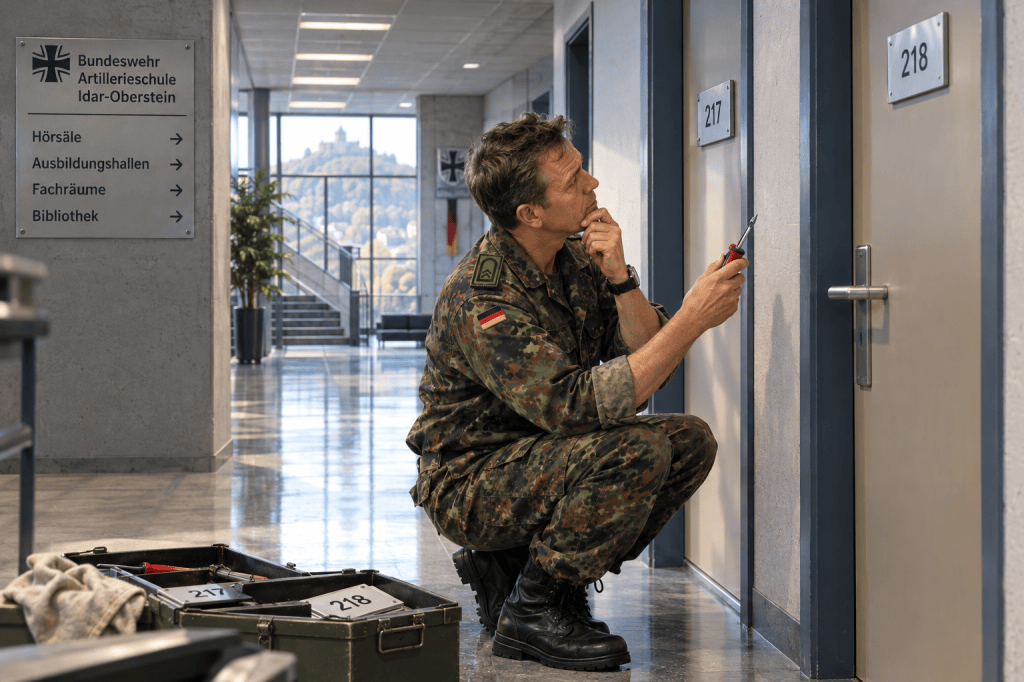
Then I switched the number plates on their doors.
Room 008 became Room 009.
And Room 009 became Room 008.
The expensive equipment stayed exactly where it was.
The working group got its officially designated room.
And the German Army was spared a considerable expense.
Whether my solution met the professional standards of the efficiency consultants, I cannot say.
From a business-management perspective, however, it was hard to beat.
Years Later
Several years later, I had already left the Army.
During a visit to the Artillery School, I happened to find myself walking through the basement of the instructional building once again.
I remembered the working group.
The uncompromising senior staff officer.
My colonel.
And that evening with Toni.
Then I looked at the numbers on the doors.
They were still arranged in exactly the same order:
007.
009.
008.


Kommentar verfassen