🇩🇪 Deutsch | 🇬🇧 English
A Tale from Town Hall
Some people make a mayor’s life difficult. And then there are those who make it difficult while also making sure the job never gets boring.
Martin belonged to the second category.
When I took office as mayor of Dettingen an der Erms in 2002, Martin was already something of a fixture at town hall. Not necessarily a popular one, but certainly a familiar one.
I, on the other hand, was new. And apparently, he thought it was time to introduce himself.
It was a Wednesday evening. Back then, we had extended office hours on Wednesdays. Town hall remained open until 7 p.m. so that people who worked during the day could take care of their business with the local government.
Martin took this opportunity very seriously.
His understanding of how to make use of a public service, however, was rather unconventional.
About five minutes before closing time, he rolled into my office.
I mean that literally.
He actually rolled.
On inline skates.
He had somehow managed to make his way upstairs on those things and was now standing in front of my desk.
Well, standing isn’t quite the right word.
He was more or less rolling in place.
To make matters worse, an impressive smell of garlic filled the room. It led me to suspect that Martin wasn’t expecting a dinner invitation that evening.
What he actually wanted, I can no longer remember. I suspect he was mainly interested in finding out just how much the new mayor was prepared to put up with.
At first, I put up with quite a lot.
But Martin returned.
And returned.
Preferably just before 7 p.m., on wheels, and occasionally with breath powerful enough to drive every vampire out of the entire Erms Valley.
Eventually, I decided that even a mayor had the right to emerge from a meeting physically intact.
We were still on formal terms in those days, and I explained that I was, of course, perfectly willing to listen to his concerns.
However, it would be helpful if he could come a little earlier, leave his inline skates outside town hall, and perhaps refrain from consuming large quantities of garlic immediately before our conversations.
I considered these fairly modest requests.
Martin apparently considered them further evidence of government interference in his personal freedom.
It took some time for us to reach an understanding.
What eventually helped was a simple measure: At 7 p.m., I ended the conversation and asked him to come back another time.
In a way, it was my first successful sanction against a man who rejected sanctions on principle.
Over time, I got to know Martin better.
He had a problem with the state.
Not with a particular government, not with an individual government agency, and certainly not just with the mayor.
No.
With the very idea of the state itself.
He wanted nothing from it.
No services, no assistance, no benefits.
In return, however, he expected the state to want nothing from him.
A remarkably straightforward philosophy of government.
Unfortunately, it had one minor flaw:
The state had never agreed to this arrangement.
This became particularly apparent when it came to property taxes.
Other citizens paid property tax.
Martin paid what he preferred to call his „annual rent.“
That neatly summed up his view of the matter: The government was collecting money for something it didn’t even own.
I won’t deny that there is room for philosophical discussion on that point.
As mayor, however, I had the rather thankless responsibility of spending less time pondering the philosophical foundations of property taxation and more time making sure the tax was actually paid.
Things became even more complicated when it came to parking.
Martin parked his car wherever he thought appropriate.
Traffic regulations occasionally took a different view.
The municipal enforcement office issued parking tickets.
Martin ignored them.
The office issued more tickets.
Martin ignored those as well.
Eventually, it began to look like a conversation between two parties, one of whom simply refused to acknowledge that the other’s correspondence had any legal significance.
The administration was at a loss.
So were the people responsible for collecting the fines.
I was still relatively new to the mayor’s office and firmly convinced that government action, if applied with sufficient determination, must eventually produce results.
So I insisted that something be done.
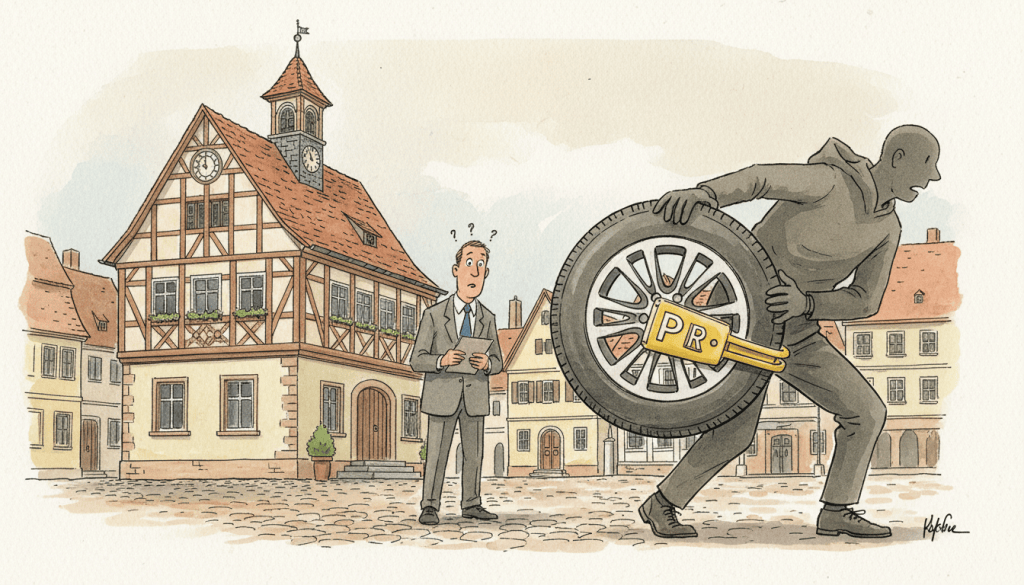
Eventually, Martin’s car was fitted with a parking boot.
A sturdy piece of government authority made of metal, firmly attached to one of his wheels.
Now, we believed, even Martin would have to recognize that the state held the upper hand.
The following day, the newspaper informed us otherwise.
Martin had simply removed the wheel, parking boot and all, fitted another wheel, and driven away.
He had even made sure the press heard about his little triumph.
There was a photograph to prove it.
He had outwitted the authorities, and the public was invited to enjoy the show.
I must admit that, initially, I found the whole affair considerably less amusing than the newspaper’s readers did.
After all, I was the one who had insisted on taking effective action.
And now there I was.
No car.
No parking boot.
And a municipal administration that had to go and retrieve its own enforcement equipment from the very man it had been trying to punish.
To make matters worse, a procedural error prevented us from pursuing the matter legally in the way we had hoped.
Martin had won.
At least we got our parking boot back.
Later, we talked about the incident.
In fact, over the years, Martin and I talked quite often.
Eventually, we even reached the point of addressing each other as du rather than the formal German Sie.
Martin explained that he had nothing against me personally.
He respected me as a human being.
Unfortunately, I also happened to represent the state, whose use of coercive powers he fundamentally rejected.
If that meant I occasionally had to act as one of the state’s „henchmen“ against him, well, that was simply the way things were.
I found this distinction rather remarkable.
Some citizens already considered me their personal enemy when I had to explain why they couldn’t put their garden fence in the middle of the sidewalk.
Martin, on the other hand, could call me a government henchman and, in the same breath, assure me that he respected me as a person.
I could live with that.
And I admit that, as the years went by, I developed a certain affection for this rather unconventional man.
Not for his unpaid parking tickets.
Nor for his belief that everyone should be free to assemble a personal legal system according to individual taste.
But for his consistency.
And for his ability to distinguish between a person and the office that person holds.
Then came our final encounter.
It was during my last year as mayor.
I ran into Martin outside town hall.
We greeted each other, and he told me that he had just taken care of something important.
He wanted out.
„Out of what?“ I asked.
I assumed he meant a club of some kind.
Perhaps the church.
After all, there are plenty of organizations you can join and later decide to leave.
„All of this,“ Martin explained.
And to make that happen, he had just obtained a copy of his birth certificate.
I was astonished.
„For heaven’s sake, Martin! That cost money!“
He confirmed that it had.
I tried to make sense of what was happening.
Here stood a man who had spent decades refusing to give the government a single cent more than absolutely necessary.
And now he had voluntarily paid that very government money in order to free himself from it.
It was rather like a prisoner buying a ticket from the warden before demanding to be released.
„But what exactly are you trying to leave?“ I asked again.
„Are you planning to move away from Dettingen?“
Absolutely not, Martin declared.
He had no intention whatsoever of leaving his hometown.
He simply wanted nothing more to do with the state.
Above all, he wanted his personal information back.
Now I was curious.
What information?
Well, all the personal information the government passed on to others without his consent.
To the GEZ, for example.
The GEZ was the name widely used in Germany for the agency associated with collecting the mandatory public broadcasting fee.
There it was again.
Another compulsory government charge.
This time, in the form of a fee for public radio and television.
I tried to explain that, as long as he remained in Germany, he couldn’t exempt himself from the country’s laws simply by declaring that he no longer wished to participate.
And that things might not necessarily be any easier outside Germany.
We walked together for a little while.
Martin remained firmly convinced that he was right.
I remained equally convinced that I was right.
We parted on friendly terms.
I still think about him occasionally.
Martin has since passed away.
I hope he wouldn’t mind my telling this story.
He was not an easy man.
He could test the patience of an entire municipal administration.
And sometimes he went to truly absurd lengths to remain faithful to his convictions.
But he was also a man who taught me something.
That you can believe another person’s views are fundamentally wrong and still respect that person.
And that government authority, however necessary it may be, would occasionally do well not to take itself quite so seriously.
When I think back on our encounters today, three images come to mind.
A man rolling into my office on inline skates.
A car driving away on a different wheel, leaving government authority behind in the form of a parking boot.
And a citizen paying the government a fee for the privilege of leaving it.
Perhaps Martin was even ahead of his time.
While everyone else was debating how to cut government bureaucracy, he had already come up with a far more radical solution.
He simply wanted to cancel his membership.
Unfortunately, the state had neglected to include a right to cancel in its terms and conditions.


Kommentar verfassen